

PRO logo
What if the biggest threat to your new master suite isn’t a bad foundation, but a single missing piece of paper? It’s a stressful thought for any homeowner. You want to expand your living space, but the fear of stop-work orders or hefty fines from overlapping jurisdictions can make anyone hesitate. If you are wondering how to get a permit for a home addition in Tarrant County, you are in the right place. Our team understands that your home is your legacy. We believe that legal compliance is the ultimate form of professional validation for your property’s structural integrity and its long-term value.
We agree that the paperwork often feels more complicated than the actual construction. Whether you are navigating the 2021 International Residential Code in Fort Worth or filing a Notice of Residential Construction in an unincorporated area, the rules can be confusing. This neighborly guide promises to clear the fog and give you a step-by-step roadmap for your 2026 project. We will preview the specific requirements for major cities like Arlington, explain the builder’s vital role in the process, and show you how to protect your home’s resale value. While our FAQ page covers many common hurdles, you can always reach us at 817-372-0211 for a professional perspective on your unique property.
PRO logo
Key Takeaways
- Determine your specific jurisdiction early to avoid filing paperwork with the wrong office and causing unnecessary project delays.
- Master the step-by-step process for how to get a permit for a home addition in Tarrant County to ensure your expansion is fully legal.
- Avoid common myths about “hidden” additions and property taxes that can lead to stop-work orders or future resale issues.
- Assemble a professional submission package using our checklist of required site plans, floor drawings, and structural details.
- Call us at 817-372-0211 to learn how our team manages the entire permitting lifecycle for a truly stress-free home addition.
Understanding the Tarrant County Permitting Landscape
A building permit is more than a receipt for a fee. It acts as your legal authorization to transform your property, ensuring that every structural change adheres to the standards established by the local Building code. If you are researching how to get a permit for a home addition in Tarrant County, it is vital to see this document as the foundation of your project. It serves as a formal agreement between you and the local government that your expansion will be safe, durable, and respectful of the surrounding community.
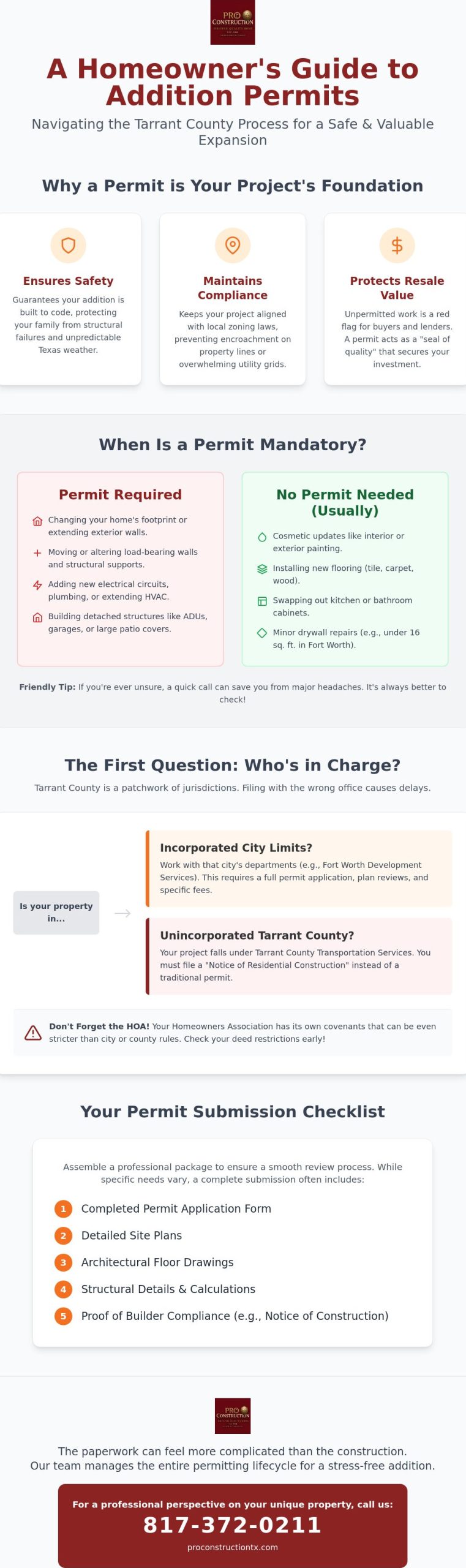
Tarrant County enforces these strict codes to prioritize three main pillars: safety, zoning compliance, and infrastructure protection. We want our neighbors’ homes to stand strong against unpredictable Texas weather while ensuring that new additions don’t overwhelm local utility grids or encroach on a neighbor’s property line. These regulations might feel like red tape, but they are actually a shield for your family’s well-being.
There is also a “Resale Reality” to consider in the fast-moving North Texas market. Unpermitted work is a significant red flag for title companies and mortgage lenders. When the time comes to sell your home, a savvy buyer’s inspector will quickly notice a master suite or a sunroom that isn’t reflected in the county tax records. This often leads to forced teardowns, expensive retroactive permitting, or massive price drops that can ruin a home sale. At PRO Construction, we view the permitting process as a “seal of quality” that protects your investment and your peace of mind.
When is a Permit Mandatory?
You’ll need a permit for any project that changes the footprint or the primary systems of your home. Structural changes like moving load-bearing walls or extending your exterior walls always require oversight. Utility expansions are also a major trigger; if you’re adding new electrical circuits, plumbing for a new bathroom, or extending HVAC ductwork, the city needs to verify the work. This also applies to secondary structures on your property, including ADUs, detached garages, and large patio covers that require structural support.
Cosmetic vs. Structural: What Can You Skip?
Not every hammer swing requires a trip to the city office. Truly cosmetic updates like painting, installing new flooring, or swapping out kitchen cabinets generally don’t need a permit. In Fort Worth, there’s even a specific allowance for minor drywall repairs under the 16-square-foot rule. However, even “minor” structural work deserves a professional eye to avoid safety hazards. If you’re unsure if your project crosses the line, check our FAQ page or call us at 817-372-0211. We’re here to help you navigate how to get a permit for a home addition in Tarrant County so your project stays on track and above board.
Navigating Jurisdictions: City Limits vs. Unincorporated Tarrant County
The first step in understanding how to get a permit for a home addition in Tarrant County is passing the “Who’s in Charge” test. Many homeowners assume that because they have a Fort Worth or Keller mailing address, they automatically fall under city rules. However, Tarrant County is a patchwork of incorporated cities and unincorporated land. If your property is within city limits, you’ll work with municipal departments like the City of Fort Worth Development Services. If you’re in a rural area outside those boundaries, your project falls under the jurisdiction of Tarrant County Transportation Services.
There is a major difference in the process. For example, in unincorporated areas, the county doesn’t issue a traditional “building permit” for residential additions. Instead, you must submit a “Notice of Residential Construction” and ensure your builder follows the International Building Code. In contrast, cities like Fort Worth or Arlington require a full permit application, plan reviews, and specific fees before a single nail is driven. We often see neighbors get frustrated when they realize that city approval doesn’t mean their Homeowners Association (HOA) is on board. Your HOA has its own set of restrictive covenants that can be even stricter than city code. We always recommend checking your deed restrictions early to avoid a “stop-work” order from your neighborhood board.
The Local Breakdown: Keller, Southlake, and Beyond
Each city has its own personality and set of rules. Keller is known for specific permitting nuances regarding custom home additions, particularly concerning setbacks and drainage. If you live in Grapevine or Colleyville, you might face additional layers of review if your home is located within a historic overlay district. Meanwhile, homeowners in growing areas like Argyle or Justin must be extra vigilant about county easements. A beautiful new garage or sunroom can’t sit on top of a utility easement, no matter how much space you think you have. If you’re feeling overwhelmed by these local quirks, you can consult with our design-build team to see how we handle these details for you.
Dealing with Overlapping Authorities
Sometimes, one permit isn’t enough. If your property sits near a creek or low-lying area, you’ll likely deal with floodplain regulations where both FEMA and Tarrant County have a say. In the “Cross Timbers” region, tree preservation ordinances are a common hurdle; removing a protected oak for your addition could result in significant fines. Finally, consider your utilities. Moving from a septic system to city sewer lines requires a completely different set of permits than a standard plumbing expansion. If you have questions about your specific lot, our FAQ page is a great resource, or you can call us directly at 817-372-0211. Understanding how to get a permit for a home addition in Tarrant County starts with knowing exactly which map your home sits on.
Common Permitting Myths and Structural Realities
Many of our neighbors believe that if a project is hidden in the backyard or tucked behind a fence, the city won’t care. This is a dangerous myth. Code enforcement officers and appraisers use satellite imagery and drive-by inspections to spot new rooflines or altered footprints. Another common worry is that permits will cause property taxes to skyrocket overnight. While an addition increases your home value, the real financial danger is an unpermitted space. If a fire or a major leak occurs in an unpermitted room, your insurance provider can legally deny the claim, leaving you with a total loss. Understanding how to get a permit for a home addition in Tarrant County isn’t just about following rules; it’s about protecting your biggest investment.
Permits act as a structural safety net. When an inspector reviews your plans, they are checking to ensure your new foundation won’t shift and your roofline won’t collapse under the weight of a Texas ice storm. This oversight connects directly to the long-term health of your house. We see permits as a seal of quality that ensures your home’s legacy remains intact for the next generation. If you have specific questions about your property’s history, you can always check our FAQ page or call us at 817-372-0211 for guidance.
The Danger of Unpermitted Structural Work
Load-bearing wall mistakes are the most frequent cause of sagging ceilings we see in North Texas. Homeowners often underestimate how a new addition shifts the weight of the existing roof. Without a permit and a professional review, you might accidentally compromise your home’s stability. Our guide to Structural Renovation Services in Tarrant County explains why professional oversight is mandatory for these changes. Incorrect framing can lead to catastrophic failure during our high-wind seasons, putting your family at risk just to save a few days of paperwork.
Protecting Your Investment and Resale Value
Tarrant County appraisers and savvy buyers look for a clear permit history during a sale. If you can’t prove the work was done to code, you may be forced to tear it down or pay for expensive retroactive inspections. The “Stop-Work Order” nightmare is real; it happens when an inspector catches an active project without a permit, resulting in heavy daily fines and immediate delays. We believe in building with integrity from day one. By securing the right documents, you gain the peace of mind that comes from knowing your home expansion is safe, legal, and truly adds value to your life.
Your Tarrant County Permit Submission Checklist
Collecting the right documents is often the most time-consuming part of your building journey. If you’re feeling stuck on how to get a permit for a home addition in Tarrant County, this consolidated checklist will help you organize your submission package before you head to the city office or open their online portal. Having these items ready prevents the back-and-forth emails that often delay projects by weeks or even months. We recommend keeping digital and physical copies of everything to ensure a smooth review process.
- Step 1: Professional Site Plan. This is a bird’s-eye view of your property showing exactly where the new addition will sit in relation to your property lines.
- Step 2: Detailed Floor Plans. You must provide “Existing vs. Proposed” drawings. These show the city how the new space flows into your current home.
- Step 3: Structural Engineering Drawings. Texas soil shifts. Because of our heavy clay, Tarrant County cities almost always require a plan stamped by a licensed Professional Engineer.
- Step 4: Energy Code Compliance (ResCheck). To meet state efficiency standards, you’ll need a report proving your new walls, windows, and insulation won’t leak energy.
- Step 5: Contractor Registration. Your builder must be registered with your specific city. We handle this for our clients to ensure there are no administrative hiccups.
The Site Plan: The Foundation of Your Application
A site plan isn’t just a simple sketch. It must define your setbacks, which are the invisible lines around your house where you aren’t allowed to build. If you cross these lines, you might face a legal battle or be forced to remove the structure. You also need to identify any easements or rights-of-way. These are areas where utility companies have the right to access lines buried under your yard. Finally, we must account for impervious surface coverage. Since North Texas clay soil doesn’t absorb water well, cities limit how much of your lot you can cover with concrete or rooflines to prevent neighborhood flooding.
Engineering and Technical Documentation
Structural additions require a stamped engineer’s seal to guarantee the safety of your family. This isn’t a place to cut corners. Your application also needs schematics for the “guts” of the expansion, including electrical and plumbing lines. As a trusted Home Addition Contractor in Keller, TX, we integrate these technical requirements into our initial design phase. This proactive approach saves you from hiring outside consultants later. If you’re ready to move past the paperwork and start building, schedule a consultation with our team or call us at 817-372-0211. You can also find more details on specific city forms on our FAQ page.
Partnering with PRO Construction for a Stress-Free Addition
Building a home addition shouldn’t feel like a second job. While the technical steps of how to get a permit for a home addition in Tarrant County can be daunting, you don’t have to walk that path alone. We take pride in managing the entire permitting lifecycle for our neighbors in Keller and Fort Worth. From the first sketch to the final signature from a city inspector, our team handles the administrative heavy lifting. We believe that your focus should be on choosing paint colors and furniture, not worrying about setbacks or energy code reports.
Our “Design-Build” approach is specifically crafted to remove friction. By integrating the permitting requirements into the initial design phase, we ensure that every square foot we plan is actually buildable under local law. This prevents the heartbreak of falling in love with a design that the city eventually rejects. When you see the PRO logo on a job site, it’s our signature of reliability and a promise that the work behind the walls is as solid as the finish on top. With 25 years of local experience, we’ve built strong professional relationships with city inspectors who know our reputation for meticulous craftsmanship and code compliance.
From Consultation to Final Inspection
Ready to Expand Your North Texas Home?
We are deeply grateful for those who serve our community. We offer specialized incentives for community pillars, including first responders and other public service professionals. It’s our way of saying thank you to those who keep Tarrant County running. Every beam we place and every permit we pull is a reflection of our commitment to integrity and consistency. We treat your home with the same respect we’d show our own neighbors, ensuring that your structural expansion adds genuine value and beauty to your property.
If you’re ready to start your project with a partner you can trust, call us at 817-372-0211 or fill out the contact form on our website. We’re here to help you navigate how to get a permit for a home addition in Tarrant County and build a legacy your family will enjoy for decades. Let’s work together to turn your vision into a legal, safe, and stunning reality.
PRO logo
Build Your Legacy with Confidence
Expanding your home is a major milestone for your family. By now, you understand that identifying your specific jurisdiction and preparing a complete submission package are the most critical steps in the process. Whether you are building in a historic district or an unincorporated area, following the proper channels ensures your new space is safe, legal, and adds true value to your property. Learning how to get a permit for a home addition in Tarrant County doesn’t have to be a solo journey that leads to paperwork anxiety.
Our team brings over 25 years of North Texas building experience to your project. As design-build experts, we handle all Tarrant County paperwork and maintain elite industry performance metrics to protect your peace of mind. We take pride in managing every technical detail so you can focus on the excitement of your new addition. Start your permitted home addition today; contact PRO Construction at 817-372-0211 or fill out our form! We look forward to helping you create a beautiful, durable space that your family will cherish for years to come.
PRO logo
Frequently Asked Questions
How much does a home addition permit cost in Tarrant County?
Permit costs vary significantly depending on your specific location. In unincorporated areas, there is no fee for filing a notice of construction. However, cities like Fort Worth start permit fees at $112 for remodels, while Arlington bases costs on the total project valuation. If you are researching how to get a permit for a home addition in Tarrant County, keep in mind that these city fees are separate from construction costs. Call 817-372-0211 for help navigating these local requirements.
How long does it take for the City of Fort Worth to approve a residential permit?
Residential permit approval in Fort Worth typically takes between seven and fourteen business days. This timeline depends on the current volume of applications and the complexity of your specific addition. Providing a complete submission package with professional engineering drawings helps speed up the process. Our team monitors the Plan Review phase closely to address any city inquiries immediately, ensuring your project stays on schedule without unnecessary administrative delays. We prioritize your timeline as much as your home’s quality.
Do I need a permit to enclose my garage in Keller, TX?
Yes, enclosing a garage requires a permit in Keller because it converts a non-habitable space into a living area. This change affects your home’s ventilation, electrical load, and insulation requirements. The city must verify that the conversion meets all safety standards for habitable rooms. We specialize in these structural renovations and can manage the entire application process for you. Feel free to reach out through our website contact form for more details on your specific conversion project.
Can I pull my own permit as a homeowner (Homestead Permit)?
You can often pull your own permit if the property is your primary homestead. Most cities in Tarrant County allow homeowners to act as their own general contractor for their personal residence. However, you are still responsible for ensuring every phase of construction meets the 2021 International Residential Code. Many of our neighbors find that having a professional handle the paperwork provides better protection for their home’s future resale value and structural integrity. We believe in getting it right the first time.
What happens if I built an addition without a permit years ago?
Building without a permit can lead to expensive fines or the requirement to tear down your new space. If you discover unpermitted work from years ago, you’ll likely need to apply for a retroactive permit. This often involves exposing the framing or plumbing for an inspector to verify safety. We recommend addressing this before listing your home for sale to avoid legal hurdles. Call 817-372-0211 to discuss how we can help you legalize your structure correctly and professionally.
Do I need a separate permit for a patio cover or pergola?
Most attached patio covers and pergolas require a permit if they are physically connected to your home’s structure. Even detached covers over 200 square feet usually need city approval to ensure they are properly anchored against North Texas winds. While these feel like minor additions, they must still comply with zoning setbacks and height restrictions. We treat every outdoor expansion with the same level of professional planning as a full room addition to protect your property and your family’s safety.
Does Tarrant County require a site plan for a room addition?
Yes, a professional site plan is a non-negotiable requirement for almost every city in our region. When researching how to get a permit for a home addition in Tarrant County, the site plan proves your project respects property setbacks and utility easements. It also helps officials manage drainage on our local clay soil. Our design-build team creates these detailed maps during the planning phase to ensure your application moves through the review process without rejection or costly delays.
How do I find out if my property is in a floodplain before applying?
You can check your property’s floodplain status through the FEMA Flood Map Service Center or the Tarrant County GIS mapping tool. Knowing this before you apply is vital because building in a floodplain requires specialized engineering and additional flood-proofing measures. If your lot is in a high-risk area, we can help you navigate the extra layers of county and federal regulations. This early research prevents costly design changes later in the building process and protects your long-term investment.
Disclaimer
Disclaimer: This material is for informational purposes only. While our automotive search engine optimization (SEO) strategies are designed to improve online visibility and foot traffic, we do not guarantee specific search engine rankings, website traffic volume, or vehicle sales. Search engine algorithms change frequently, and results will vary based on market competition, dealership location, website history, and other factors outside of our control. Case studies or past performance metrics shared in this material are examples of prior success and do not guarantee future results.