
Imagine sitting in your living room in Southlake or Fort Worth, watching a thin crack slowly crawl up your drywall, and wondering if your roof is about to become your floor. It’s a stressful feeling that many of our neighbors share, especially since our unique regional environment is so demanding on properties built decades ago. We understand the deep anxiety that comes with spotting common structural problems in older homes, from those sticking bedroom doors to the uneven floors that make you feel like you’re walking on a ship. You shouldn’t have to guess if your open-concept dream will cause a collapse or if the shifting ground is finally winning the battle against your foundation.
We agree that your home should be a place of permanence and craftsmanship, not a source of worry. That’s why we’ve put together this expert renovation roadmap to help you protect your investment. You’ll learn how to identify the specific criteria that distinguish minor settling from genuine structural danger. We’ll also preview the steps for resolving these issues during a renovation so you can move forward with total peace of mind. If you’re ready for an honest assessment, you can reach our team at 817-372-0211 or fill out our website contact form to start a conversation about your home’s future.
Key Takeaways
- Understand why the unique clay soil in Keller and Fort Worth puts constant pressure on your home’s foundation components.
- Learn to spot common structural problems in older homes by identifying interior red flags like sticking doors and exterior cracks in your brick veneer.
- Discover how simple maintenance oversights can lead to hidden dangers like rotted rim joists and subterranean termite damage.
- Avoid the “open concept” trap by learning the critical differences between load-bearing and partition walls before you start a renovation.
- Use our expert roadmap to ensure your structural renovations are handled with integrity, and reach out to us at 817-372-0211 for a professional consultation.
Understanding the Foundation of North Texas Structural Issues
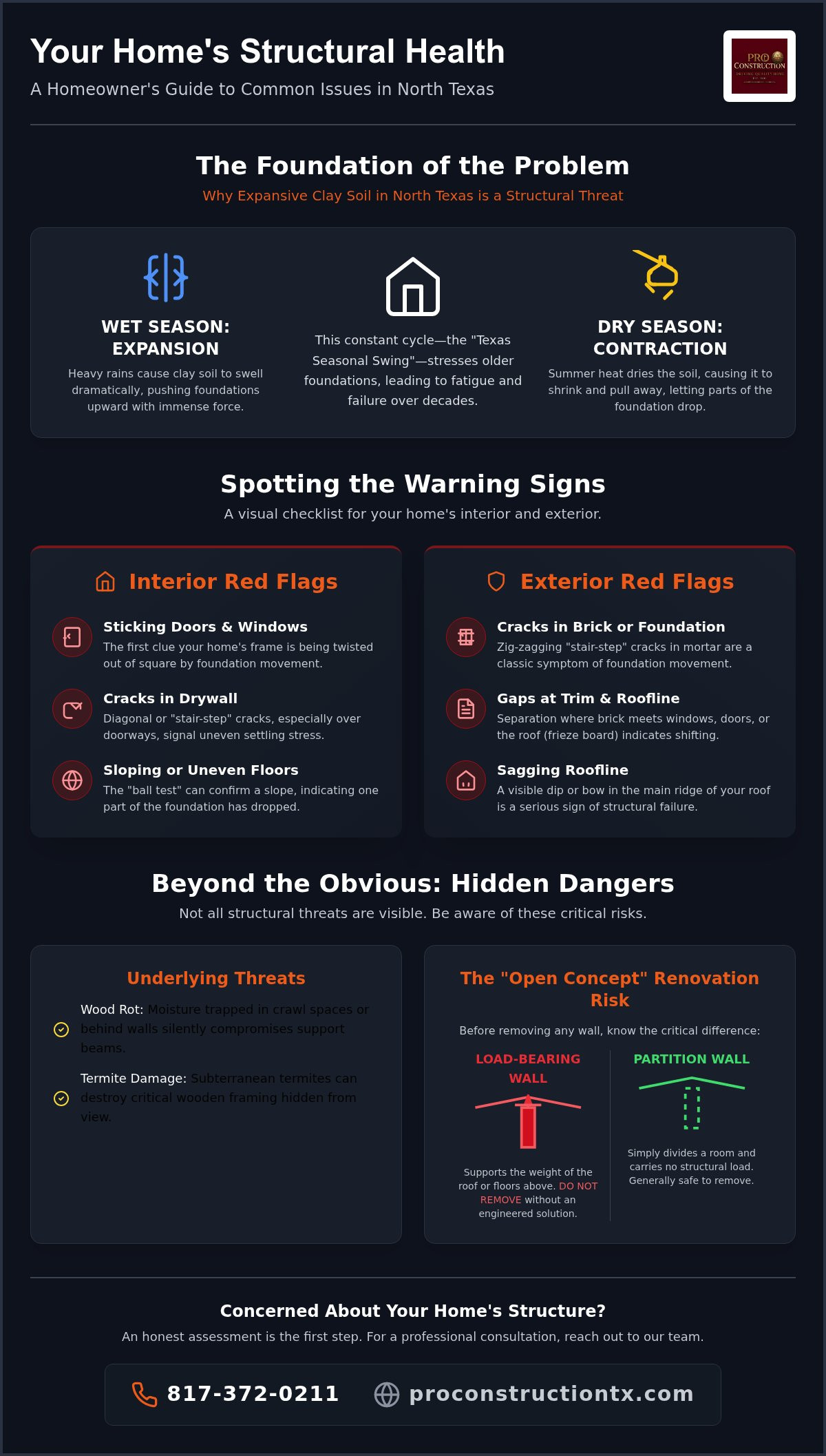
Structural problems occur when the core bones of your house can no longer safely support the load they were designed to carry. This loss of structural integrity and failure of load-bearing components can lead to serious safety risks if left unaddressed. In North Texas, these issues aren’t just about the age of the materials; they’re tied to the very ground we build on. Our region is famous for expansive clay soil, particularly in cities like Keller and Fort Worth. This soil acts like a giant sponge, swelling significantly during our heavy spring rains and shrinking during the brutal Texas summer heat. This constant cycle of expansion and contraction puts immense pressure on foundations, leading to common structural problems in older homes that were built before modern soil stabilization techniques became standard.
Homes built during the construction booms of the 1970s and 80s are currently reaching a point of specific fatigue. During this era, building codes were different, and many slabs weren’t engineered to withstand decades of the “Texas Seasonal Swing.” Over forty or fifty years, the repetitive stress of the soil shifting beneath the concrete eventually causes the material to tire and crack. When we see these issues, it is often a sign that the home has reached its limit of flexibility. The “PRO logo” on our projects represents our commitment to fixing these issues with integrity, ensuring your home stands strong for the next fifty years.
The Science of Shifting Soil in Tarrant County
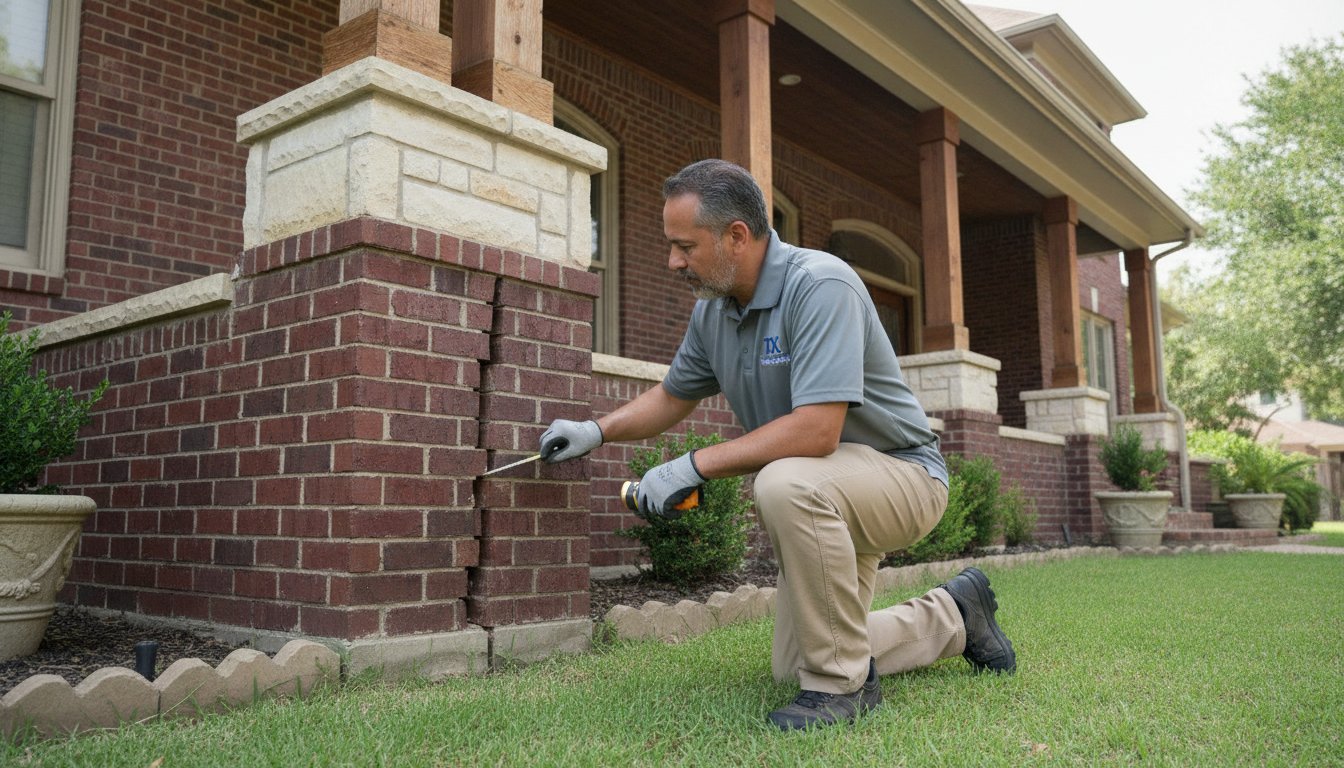
Clay soil in Tarrant County is a moving target. When it’s wet, it pushes up; when it’s dry, it pulls away. If your home settles evenly, you might never notice a change. However, we often see differential settlement, where one corner of the house drops while the rest stays put. This creates the “stair-step” cracks you see in exterior brickwork. Surprisingly, even your neighbor’s foundation repair can affect you. If they install piers that change the moisture levels or support on their side of the property line, it can shift the soil balance under your own home. We’ve seen many cases where a repair next door triggered a shift in a neighboring property.
Slab-on-Grade vs. Pier and Beam Challenges
In areas like Grapevine and Argyle, slab-on-grade foundations are the norm, but they often suffer from corner leaks or center heaving as the clay fluctuates. Older pier and beam homes face different hurdles. These structures rely on a crawl space that often traps moisture, leading to wood rot or the need for constant “shimming” to keep floors level. Before you plan any home additions or ADUs, it’s vital to identify your home’s specific structural footprint. Adding weight to an already stressed foundation is a recipe for trouble. If you’re concerned about your foundation’s health, call us at 817-372-0211 or visit our website to fill out a contact form for a professional consultation.
The Most Common Structural Red Flags in Older Homes
Identifying common structural problems in older homes often starts with a simple walk through your living room. When you notice a door that suddenly sticks or a window that won’t latch, it’s easy to blame the Texas humidity. While moisture does play a role, these are often the first signs that your home’s frame is no longer square. Inside, look for “stair-step” cracks in the drywall, especially around the corners of door frames and windows. These diagonal lines suggest that one part of the house is moving faster than the rest, pulling the wall apart at its weakest points.
On the exterior, the warnings are often more dramatic. Large gaps in the brick veneer or separation where the brick meets the roofline, known as frieze board gaps, indicate significant shifting. Pay close attention to your garage door. Because garage openings are large and lack the internal support of a standard wall, they’re often the first place you’ll see masonry pulling away. If you spot these signs, it’s time to think about structural renovations before the damage spreads to the rest of the house.
You can also check your floor’s health with the “ball test.” Simply place a marble or a small ball on a hard surface and see if it consistently rolls toward one corner. While no house is perfectly level, a fast-rolling ball indicates a slope that likely stems from foundation failure. Up above, look at your roofline from the street. A visible dip in the ridgepole, the very top peak of your roof, signals that the attic framing is failing to support the weight of the shingles and decking. Similarly, a chimney pulling away from the house is a major warning sign; specialized providers like Best Chimney Services recommend immediate inspection if you notice gaps between the masonry and the siding.
Distinguishing Settling Cracks from Structural Failure
Not every crack is a catastrophe. We use the “Quarter Rule” as a general guide; if a crack is wider than 1/4 inch, you definitely need a professional assessment. Vertical cracks are often just signs of natural settling. However, horizontal cracks in a foundation or basement wall are much more concerning because they suggest lateral pressure from the surrounding soil. Controlling unwanted moisture is vital here, as water-logged clay exerts immense force against your home’s footprint. You can monitor movement by marking the ends of a crack with a pencil to see if it grows over a single summer.
Outdoor Structures as Early Warning Signs
Your backyard can also act as a canary in the coal mine. A leaning pergola or a deck that is pulling away from the house often points to larger drainage issues that will eventually reach your foundation. We frequently see common structural problems in older homes caused by “DIY” patio covers that were added without proper footings. These heavy structures can pull on the existing roofline and cause sagging. If you’re planning an upgrade, check out our guide on custom patio covers in Keller TX to see how we ensure every project maintains the integrity of your original home. For an expert look at your property, call us at 817-372-0211 or fill out our website contact form.
Hidden Dangers: Wood Rot, Termites, and Outdated Framing
While cracks in the drywall are certainly stressful, the most dangerous common structural problems in older homes are often the ones you can’t see from the curb. Subterranean termites are a constant threat in our region. These “Silent Destroyers” can eat through structural supports for years without ever being noticed by a homeowner. We often find that water intrusion is their best friend. If your gutters are clogged or poorly maintained, water overflows and sits against your home’s perimeter. This constant moisture eventually rots out your rim joists and sill plates, which are the foundational wooden components that sit directly on your concrete slab or pier. Once these rot, the entire frame of your house can begin to dip.
We also see frequent issues with the framing itself. Many houses built in the 1960s used beams that were perfectly fine for the lightweight shingles of that era. Today, many neighbors switch to heavy modern roofing materials or add solar panels without realizing those old beams might sag under the extra weight. During our structural renovation services in Tarrant County, we frequently uncover “Handyman” modifications. These are spots where a previous owner might have cut through a floor joist to install a drain pipe or removed a support post to make room for a water heater. These small, unengineered changes compromise the building over time. Our team looks for the “PRO logo” on our internal documentation to ensure every fix meets our high standards for safety and integrity.
The Moisture Problem in Texas Crawlspaces
In places like Argyle, many older homes feature crawlspaces that trap North Texas humidity. This damp air fuels fungal growth in your floor joists. If you notice “soft floors” that feel spongy or bouncy when you walk on them, your home’s integrity is likely at risk. We believe in doing things right the first time, which usually involves installing vapor barriers and ensuring proper ventilation to keep these areas dry. This simple step can prevent thousands of dollars in future framing repairs.
Identifying Termite and Pest Damage
Keep an eye out for “mud tubes” on your foundation. These look like small, pencil-sized tunnels made of dirt and are a clear sign of termite activity. It’s important to distinguish between cosmetic surface damage and structural honeycombing, where the inside of the wood is completely hollowed out. Because these issues are so well hidden, we always recommend a professional pest inspection before you start any home additions or major projects. If you’re worried about what’s hiding in your walls, call us at 817-372-0211 or fill out our website contact form so we can help you assess your home’s health.
Modernizing Your Layout: The Risks of DIY Structural Changes
Many homeowners in North Texas dream of tearing down walls to create a bright, open-concept kitchen. However, this “open concept trap” is a leading cause of common structural problems in older homes when handled without professional oversight. If you remove a wall that was secretly supporting your ceiling, you won’t just have a bigger room; you’ll have a sagging roofline or, in extreme cases, a total collapse. Distinguishing a load-bearing wall from a simple partition wall isn’t always easy. While some people look for double top plates or walls running perpendicular to joists, you should never guess. A load-bearing wall carries the weight of everything above it, and removing it requires a calculated plan to transfer that weight elsewhere safely.
When we replace a long wall with a single beam and two posts, we create what builders call a “point load.” This concentrates tons of pressure onto two small spots on your floor. If your foundation wasn’t designed for that specific weight, the slab will crack or the pier will sink. This is why professional engineering is a non-negotiable part of building a custom home or adding a significant addition to an existing structure. We ensure that every weight-bearing change is supported all the way down to the ground.
Removing Load-Bearing Walls Safely
Removing load-bearing walls safely starts with temporary shoring. We build a temporary support structure to hold up the ceiling while we work. For the permanent fix, we typically use Laminated Veneer Lumber (LVL) beams. These engineered beams are stronger than traditional solid wood and can span much wider distances without sagging over time. Beyond the physical work, we also manage the complex permitting and administrative tasks required by cities like Keller. We ensure every structural change is documented and approved, protecting your home’s value and your family’s safety.
Avoiding the “Handyman” Structural Fail
Over our 25 years of experience, we’ve seen plenty of “handyman” structural fails that lead to common structural problems in older homes. We often find unpermitted renovations where a previous owner tried “sistering” a joist to fix a sag without addressing the root cause of the weight imbalance. These hidden DIY disasters often come to light only when you start your own project. Our team is trained to spot these red flags before they become your nightmare. We look for the “PRO logo” on our internal project plans as a signature of our discipline and quality. If you’re planning to open up your floor plan, schedule a structural consultation with our team today at 817-372-0211 or through our website contact form to ensure your home stays safe and sound.
Navigating Structural Renovations with PRO Construction
Dealing with common structural problems in older homes can feel like an overwhelming burden for any family. We understand that your house is more than just a building; it’s the foundation of your life in North Texas. Our approach is rooted in neighborly professionalism and a grounded sense of reliability. This commitment to quality is mirrored by regional specialists like Arkansas Home Improvement, who offer dedicated exterior contracting and remodeling services in Central Arkansas. When you see the “PRO logo” on our project sites, it stands as a promise of consistency and meticulous planning. We don’t just patch up issues; we provide permanent solutions that restore the durability of your regional landscape. Every project we undertake is a collaborative effort where we prioritize your peace of mind and the long-term safety of your investment over mere profit.
We take great pride in our disciplined work ethic and our deep roots in the community. This commitment is most visible in our specialized incentives for public service pillars like teachers, first responders, and healthcare workers. It’s our way of showing gratitude to those who keep our local areas strong. By focusing exclusively on residential projects, we maintain an expert edge that allows us to manage the complex administrative and regulatory tasks that often stall major renovations. We speak the language of local building departments and structural engineers to ensure every home addition or structural fix is built to last for decades.
Our Methodical Process for Major Structural Work
Working with us follows a logical and predictable rhythm designed to eliminate uncertainty. Our process begins with a detailed professional consultation where we assess the unique “soil and storm” tax your property has faced. From there, we move into the specifics of the work, which often includes:
- Collaborative Engineering: We partner with trusted structural engineers to verify that every new beam or foundation pier is perfectly placed.
- Regulatory Management: Our team handles the “Texas-sized” challenges of local permitting and code compliance in cities like Fort Worth and Keller.
- Craftsmanship-Focused Execution: We use high-quality materials and time-tested methods to resolve common structural problems in older homes.
- Final Quality Inspection: We don’t consider a job finished until it meets our elite industry performance standards and passes a rigorous final check.
Start Your Home Transformation Today
You don’t have to live with the fear that a sagging ceiling or a cracked foundation will ruin your home’s value. Whether you’re looking to secure your current structure or you’re planning a major expansion, we’re here to provide the technical confidence you need. If you have questions about project timelines or how we handle specific structural challenges, please refer to our FAQ page for detailed answers based on our professional knowledge base. We believe in transparency and want you to feel fully informed before we ever swing a hammer. Ready to restore your home’s integrity? Call us today at 817-372-0211 or fill out our contact form to schedule your initial consultation with a local expert who cares.
Securing Your Home’s Future in North Texas
Your home is your sanctuary, but the shifting North Texas clay never stops moving. We’ve explored how to identify red flags like sticking doors and why removing walls for an open layout requires expert engineering. Addressing common structural problems in older homes early is the best way to prevent minor settling from turning into a major failure. It’s about maintaining the durability and craftsmanship your family deserves while protecting your long-term property value. Our neighborly approach ensures that your house remains a place of safety and pride for years to come.
With over 25 years of North Texas building experience, our team brings A+ rated neighborly professionalism to every project. We specialize in complex structural renovations and additions, ensuring your home stands strong against the local soil tax. When you see the PRO logo on our plans, you know you’re getting a project built with total integrity. If you’re ready to move forward with confidence, we’re here as your local partner. Trust the local experts with your home’s integrity and fill out our contact form today, or call us directly at 817-372-0211. Let’s work together to make your home safe and beautiful for the next generation. We look forward to building something lasting with you.
Frequently Asked Questions
How do I know if a crack in my wall is structural?
You can identify a structural crack by checking its width and direction. If a crack is wider than a quarter inch or runs horizontally across a foundation wall, it’s likely a sign of a serious issue. We also look for stair-step patterns in exterior brickwork that suggest differential settlement. If you’re unsure about a specific crack, it’s best to call us at 817-372-0211 for a professional assessment of your home’s integrity.
Is it worth fixing structural problems in a 50-year-old home?
Yes, investing in repairs for an older home is vital for protecting both your family’s safety and your property’s resale value. Many common structural problems in older homes are entirely fixable and, once resolved, allow the house to remain stable for several more decades. We believe in craftsmanship that stands the test of time. Addressing these issues now prevents more expensive damage later, especially before you start any home additions or major renovations.
Can I remove a wall in my house without a structural engineer?
You should never remove a wall without a professional assessment to determine if it’s load-bearing. Even a wall that looks simple might be supporting the roof or a second floor. We collaborate with structural engineers on every project to ensure your home’s bones remain intact. Skipping this step can lead to sagging ceilings or even a total structural failure during your project. Our team handles all the complex engineering and permitting tasks for you.
How much does it typically cost to fix foundation issues in Keller?
Foundation repair costs vary significantly based on the number of piers required and the specific soil stabilization methods used. While we don’t provide generic pricing without an inspection, industry data shows that minor repairs are much more affordable than major structural overhauls. We recommend filling out our website contact form so we can discuss your specific situation in Keller or Fort Worth. Our goal is to provide a durable solution that fits your family’s needs.
What are the signs that my roof has structural damage?
A sagging ridgepole or a visible dip in the roofline from the street are clear indicators of structural roof damage. Inside the attic, you might also spot cracked rafters or daylight peeking through where the walls and roof meet. These issues often stem from undersized beams or the added weight of modern shingles. We look for the PRO logo on our project documentation to signify that every roofing component is engineered for long-term regional durability.
Do home additions require a new foundation assessment?
Yes, every home addition requires a comprehensive foundation assessment to ensure the existing structure can handle the extra weight. Adding a new room or a garage creates new point loads that could cause your original slab to crack if it’s not properly reinforced. We take a methodical approach to these assessments, ensuring your new space is as stable as the original build. This step is essential for maintaining the integrity of your entire property.
How long does a typical structural renovation take?
A typical structural renovation can take anywhere from three weeks to several months, depending on the complexity of the work and city permitting. We manage all the administrative and regulatory tasks to keep your project moving at a steady pace. For a more detailed look at project timelines and what to expect during construction, you can visit our FAQ page. You can also reach out to us at 817-372-0211 to start planning your home’s transformation today.
Disclaimer
Disclaimer: This material is for informational purposes only. While our automotive search engine optimization (SEO) strategies are designed to improve online visibility and foot traffic, we do not guarantee specific search engine rankings, website traffic volume, or vehicle sales. Search engine algorithms change frequently, and results will vary based on market competition, dealership location, website history, and other factors outside of our control. Case studies or past performance metrics shared in this material are examples of prior success and do not guarantee future results.