
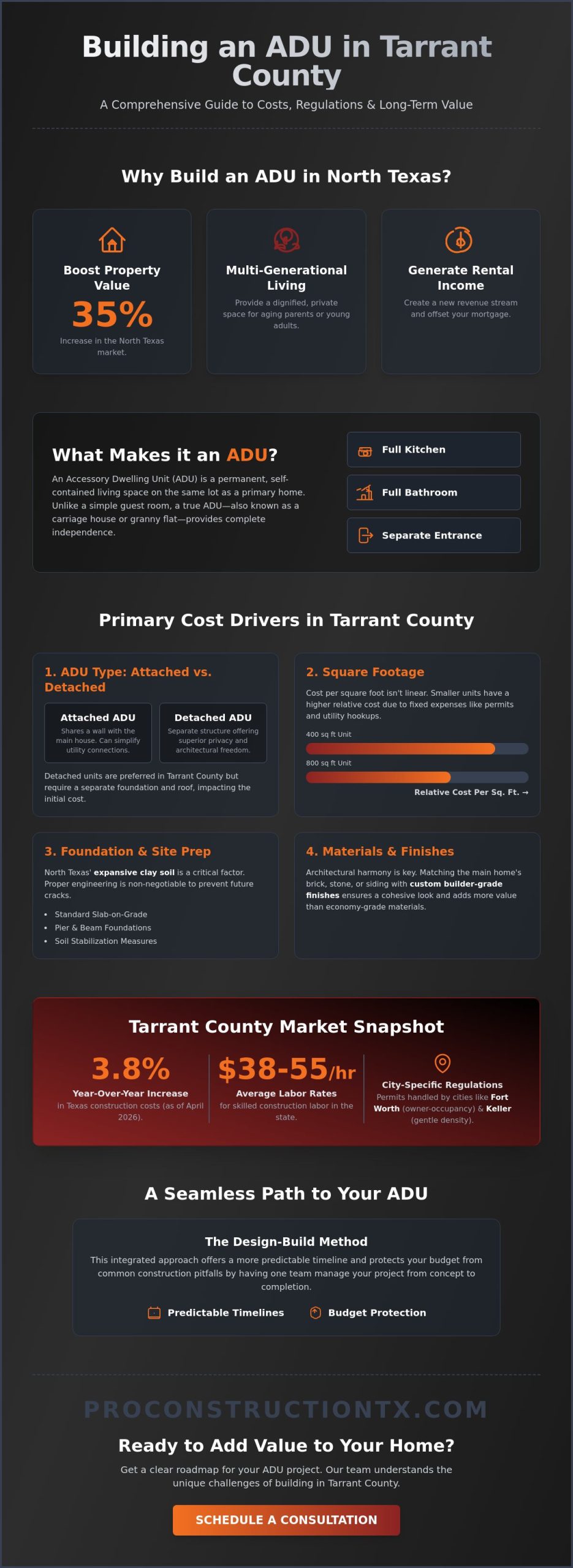
Did you know that adding a secondary dwelling can increase your property value by as much as 35% in the current North Texas market? You’ve likely noticed more neighbors in Fort Worth and Arlington investing in these structures to house aging parents or generate rental income. It’s natural to feel some hesitation when you’re trying to calculate the cost to build an ADU in Tarrant County. Between Keller’s specific zoning rules and Fort Worth’s unique requirements, the path to a finished project often feels hidden behind a mountain of paperwork and technical questions.
We understand that your primary concern is building a legacy that lasts without being blindsided by hidden expenses. This guide will provide the clarity you need to move forward with confidence. You’ll discover the primary cost drivers that affect your budget, such as utility infrastructure and foundation stability on our region’s expansive clay soil. We also break down the specific permit regulations for major local municipalities. By the time you finish reading, you’ll have a clear roadmap for creating a high-quality structure that adds genuine value to your home and peace of mind for your family.
Key Takeaways
- Define the role of ADUs as durable solutions for multi-generational living and rental opportunities in our local North Texas neighborhoods.
- Identify the critical factors affecting the total cost to build an ADU in Tarrant County, from architectural matching to specific utility tap fees.
- Prepare for city-specific permitting requirements to ensure your project meets local building codes without navigating unexpected administrative hurdles.
- Evaluate the long-term financial benefits of your investment by analyzing local rental demand and projected property value increases.
- Discover why the design-build method offers a more predictable timeline and protects your budget from common construction pitfalls.
Understanding ADUs in the Tarrant County Context
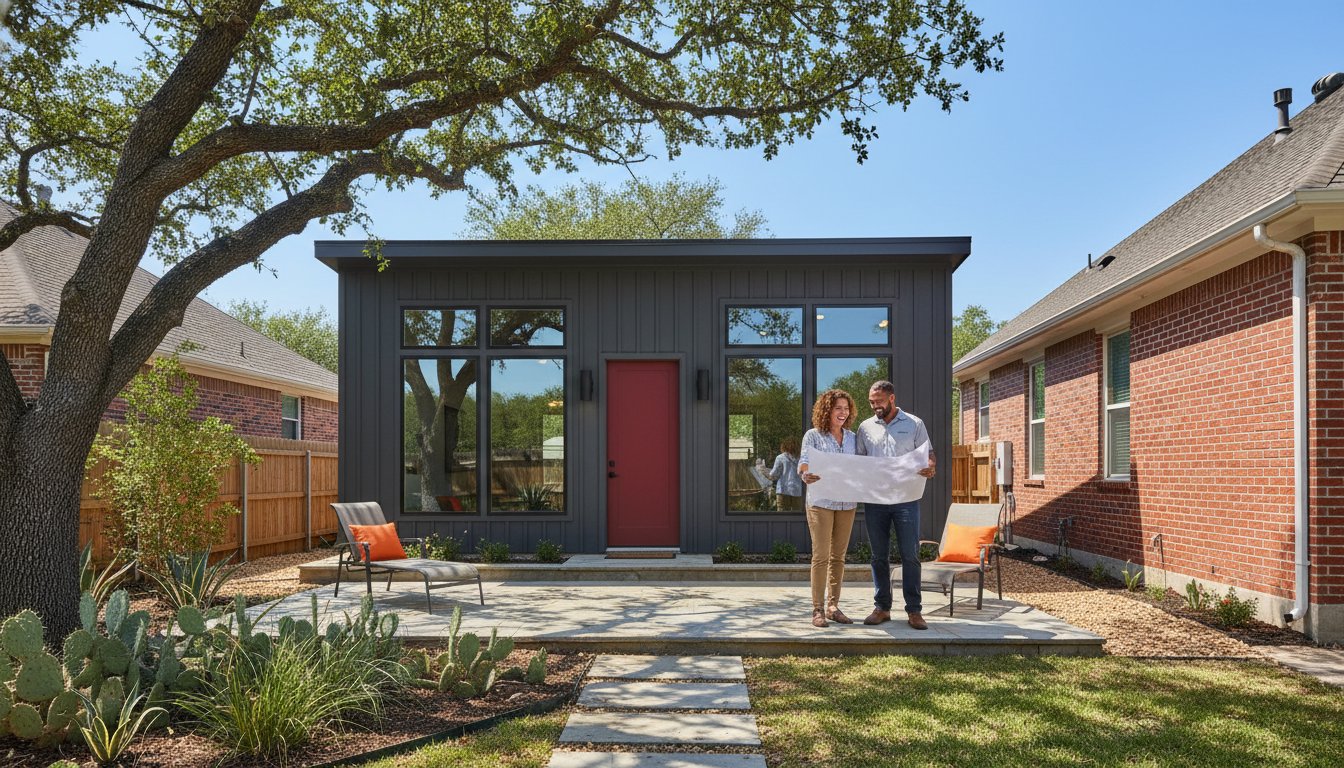
An Accessory Dwelling Unit, or ADU, represents a permanent secondary home located on the same lot as your primary residence. In our North Texas neighborhoods, you might hear these structures called carriage houses, backyard cottages, or even granny flats. Understanding Accessory Dwelling Units is essential for any homeowner considering this investment, as the term covers any self-contained living space with its own kitchen, bathroom, and entrance. This independence is what separates a true ADU from a simple guest room or a pool house. Families in our region are increasingly turning to these structures to support multi-generational living, providing a dignified space for aging parents or a private start for young adults returning home.
The distinction lies in the ability to live entirely separate from the main house. A guest house might offer a place to sleep, but a true ADU features a full kitchen and independent utility hookups. Understanding these functional differences is the first step in estimating the cost to build an ADU in Tarrant County accurately. We’ve seen a surge in interest across the metroplex as homeowners realize that these units provide a flexible solution for changing family needs while protecting the long-term value of their property.
The Legal Landscape of North Texas ADUs
Local zoning ordinances dictate what you can build and where. Tarrant County doesn’t issue these permits directly; instead, you’ll work with your specific city’s development services. In Fort Worth, for instance, owner-occupancy is often a requirement, meaning you must live on the property to legally maintain the unit. Cities like Keller are embracing “gentle density,” allowing homeowners to maximize their land use while preserving the suburban character we all value. These rules ensure that new construction respects the integrity of the existing neighborhood and doesn’t overwhelm local infrastructure.
Attached vs. Detached: Which Fits Your Property?
Choosing between an attached or detached layout is a pivotal decision. An attached ADU shares at least one wall with your main house, which can sometimes simplify utility connections. However, detached cottages offer superior privacy and architectural freedom. This choice significantly influences the cost to build an ADU in Tarrant County. While a detached unit requires a separate foundation and roof, it avoids the structural complexities of cutting into your current home’s frame. We find that most Tarrant County lots provide ample space for detached units, which remain the preferred choice for those seeking a true sense of separation and independence for their guests or family members.
Primary Cost Drivers: Square Footage, Type, and Materials
Estimating the cost to build an ADU in Tarrant County requires a move beyond simple averages. While square footage is a major factor, it doesn’t scale linearly. A smaller 400-square-foot unit often carries a higher price per square foot than an 800-square-foot unit because fixed expenses, like utility hookups and permitting, are spread over a smaller area. As of April 2026, general construction costs in Texas have seen a 3.8% year-over-year increase. This rise reflects higher material costs and labor rates that now average between $38 and $55 per hour across the state. Meticulous planning is the only way to protect your budget from these market shifts.
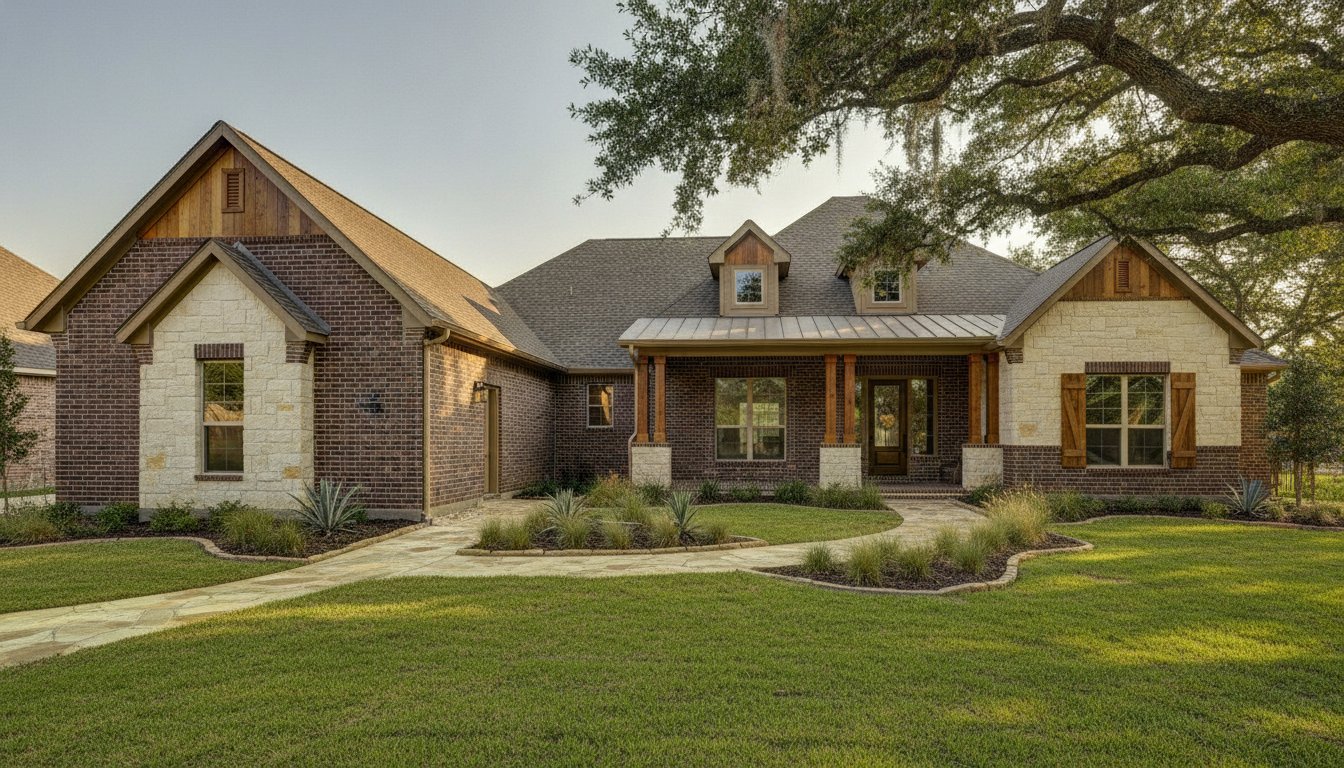
Architectural harmony also plays a significant role in your final investment. Most homeowners in neighborhoods like Grapevine or Mansfield want their ADU to match the primary residence’s brick, stone, or siding. Using custom builder-grade finishes ensures the new structure looks like a natural extension of your property rather than an afterthought. While economy-grade materials exist, they often lack the durability required for North Texas weather. If you’re ready to explore how these variables apply to your specific lot, consider a consultation for ADU planning and construction with a local expert who understands our regional standards.
Foundation and Structural Integrity
North Texas is famous for its expansive clay soil, particularly in Keller and Southlake. This soil shifts significantly with moisture changes, which can lead to foundation cracks if not addressed properly. You cannot cut corners here. While a standard slab-on-grade is common, some properties require pier and beam foundations or additional soil stabilization to ensure long-term stability. Investing in professional engineering at the start prevents thousands of dollars in structural repairs ten years down the road. Stability is the hallmark of a well-built home.
Interior Layout and Mechanical Complexity
The “wet wall” rule is a practical way to manage plumbing expenses. By keeping the kitchen and bathroom back-to-back, you reduce the amount of piping required. Mechanical systems also impact your total cost to build an ADU in Tarrant County. High-efficiency mini-split HVAC systems are often more cost-effective than extending ductwork from the main house. Additionally, your electrical panel must be able to handle the load of modern appliances. We prioritize organized, logical layouts that maximize every inch of space while keeping mechanical runs short and efficient.
Navigating Tarrant County Regulations and Permitting Fees
Administrative costs often surprise homeowners who only focus on the physical build. While the structure is the most visible part of your investment, the “soft costs” of bureaucracy are equally critical to your budget. In Fort Worth, for example, total permit costs typically range from $2,000 to $8,000. This includes plan checks, building permits based on construction value, and impact fees. Meanwhile, Arlington offers a different scale, with fees usually falling between $600 and $3,500. These discrepancies highlight why you must research your specific municipality early to understand the true cost to build an ADU in Tarrant County.
Utility tap fees represent another significant variable. Connecting your ADU to city water, sewer, and power isn’t always as simple as running a line from the main house. Some cities require independent meters or separate taps, which can add several thousand dollars to your total. Before you break ground, a professional land survey is non-negotiable. It identifies existing easements and property lines that could halt construction if ignored. If you live in a deed-restricted neighborhood in Southlake or Grapevine, your HOA may have even stricter rules than the city regarding exterior materials or roof heights. We take pride in managing these complex administrative tasks so you don’t have to worry about the details.
The Permitting Roadmap for 2026
Success starts with a clear plan. First, you must obtain zoning verification to ensure an ADU is allowed on your specific lot. Once confirmed, you’ll move into the structural engineering and architectural review phase. This ensures the building is safe and matches local standards. Finally, you submit the formal building permit application. Having a partner who understands the nuances of local development services departments can save weeks of back-and-forth revisions and keep your project on schedule.
Setbacks and Lot Coverage Rules
Your property has a limit on how much “impervious surface” can cover the ground. This calculation includes your main home, driveway, and the new ADU. Most Tarrant County cities, including Fort Worth and Arlington, require a 5-foot setback from the rear and side property lines. Height restrictions also vary; Fort Worth allows up to 25 feet, while Arlington typically caps detached units at 20 feet. These rules prevent overcrowding and ensure your new addition doesn’t negatively impact your neighbors’ privacy or regional drainage patterns.
Assessing the Long-Term ROI of a North Texas ADU
Building an ADU is a strategic investment in your family’s future and your property’s financial health. While the initial cost to build an ADU in Tarrant County requires a commitment, the long-term returns are compelling. Recent market data indicates that properties featuring an ADU are typically priced 35% higher than comparable homes without one. Local appraisers look for high-quality construction that matches the main home’s architecture, as this consistency signals durability and planning to potential buyers. A well-executed project doesn’t just add space; it transforms your lot into a multi-generational asset that remains attractive in any market cycle.
The financial benefits extend beyond eventual resale. For families housing aging parents, the “invisible ROI” is found in the substantial savings compared to the monthly costs of local assisted living facilities. You’re creating a private, dignified environment while keeping your loved ones close. When the time comes to sell, an ADU often makes a home easier to move. Buyers in 2026 prioritize flexibility, and a turnkey secondary suite offers them a ready-made solution for a home office, a guest house, or a steady income stream. If you’re weighing the benefits of different project types, you can contact our team to discuss which structure best serves your long-term goals.
Rental Market Analysis for Tarrant County
Demand for independent living spaces remains high in areas like Fort Worth and Grapevine. An ADU in Fort Worth can generate between $1,000 and $1,800 per month in rental income, providing an annual return on investment of 8% to 12% in strong rental markets. It’s essential to check city-specific regulations, as some municipalities have owner-occupancy requirements or specific rules for short-term versus long-term stays. Additionally, adding a secondary dwelling will impact your property taxes, so we recommend consulting with a local professional to understand the yearly implications for your specific lot.
Comparing ADUs to Other Home Additions
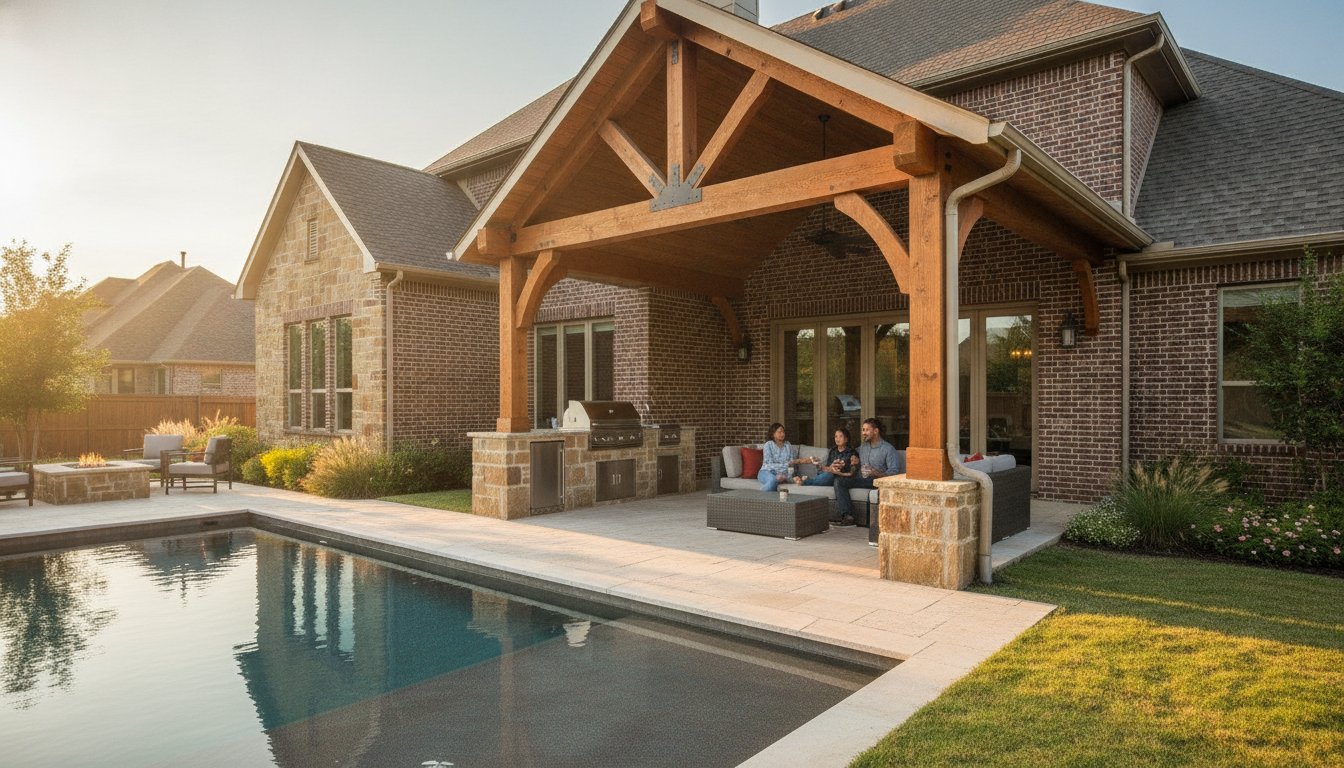
Choosing an ADU over a traditional room expansion often yields a higher ROI because of the unit’s complete independence. While home addition contractors Fort Worth can help you expand your existing footprint, a standalone ADU offers a level of privacy that a standard room cannot match. You can even enhance the livability of the unit by integrating custom patio covers Keller TX to create a functional outdoor living area. This combination maximizes the usable square footage of your property and justifies the cost to build an ADU in Tarrant County by providing a comprehensive, high-end living experience for tenants or family members.
The PRO Construction Approach to Seamless ADU Development
Managing the cost to build an ADU in Tarrant County requires more than just a set of blueprints. It demands a partner who understands how every nail and beam interacts with local soil and city ordinances. We utilize a design-build approach to provide a seamless experience for our neighbors. By housing both the planning and construction phases under one roof, we eliminate the communication gaps that often lead to budget creep and project delays. Our team brings over 25 years of experience to every job site, ensuring your project moves from the initial land survey to the final inspection with precision.
Building a secondary suite is a complex lifecycle that involves architectural design, engineering, and rigorous city inspections. We take pride in managing these moving parts so you can focus on your family. Our commitment to architectural harmony means your new ADU will look like it was always part of your original home’s design. We don’t just build boxes; we create durable, high-quality structures that stand the test of time and North Texas weather. This methodical approach protects your investment and ensures the finished product adds real, measurable value to your property.
Expertise in Structural Renovations
Our deep roots in structural renovation services Tarrant County provide a unique advantage for your ADU project. Whether you’re building a detached cottage or an attached suite, structural integrity is our highest priority. We handle the most complex framing and foundation challenges, ensuring the new unit is safe and stable on our region’s shifting clay. This expertise allows us to integrate modern amenities into your property while maintaining the structural health of your primary residence. We ensure that every addition feels like a natural, intentional extension of your home.
Start Your Tarrant County ADU Project
Every successful project begins with an honest conversation. A professional consultation is the most effective way to establish an accurate budget and identify potential site challenges before they become expensive problems. We handle the heavy lifting of securing permits and coordinating with city officials in Fort Worth, Keller, and across the county. This allows you to enjoy the process of watching your vision come to life without the stress of administrative hurdles. Schedule your ADU consultation with PRO Construction today to take the first step toward a high-quality addition that serves your family for decades.
Building Your Legacy with Confidence
Deciding to add a secondary dwelling to your property is a significant step toward securing your family’s comfort and financial future. We’ve explored how navigating local ordinances and prioritizing foundation stability on our region’s clay soil are essential for a successful build. While the cost to build an ADU in Tarrant County involves several variables, focusing on high-quality materials and architectural harmony ensures your investment remains a valuable asset for decades. You don’t have to manage these complex decisions alone.
With over 25 years of North Texas building experience, we specialize in design-build project management and possess a deep understanding of local Tarrant County building codes. We take pride in handling the technical and administrative details so you can enjoy the transformation of your home. Your vision deserves the precision and care of a local expert who treats every project with neighborly professionalism. Contact PRO Construction for a custom ADU quote in Tarrant County. We’re ready to help you create a space that perfectly serves your family’s needs and enhances your property’s long-term value.
Frequently Asked Questions
Do I need a separate permit for an ADU in Keller, TX?
Yes, you must obtain a specific building permit from the City of Keller’s development services department. Since Tarrant County doesn’t issue permits for construction within incorporated cities, your project requires a local review of site plans and structural designs. This process ensures your new addition respects Keller’s specific zoning and safety standards.
Can I build an ADU if I have a septic system instead of city sewer?
Yes, building with a septic system is possible, but it requires a capacity evaluation. You must verify that your existing tank and drain field can handle the additional waste from a secondary dwelling. If your current system is undersized for the total number of bedrooms on the lot, an upgrade to your septic infrastructure will be necessary.
How long does the typical ADU construction process take in Tarrant County?
The entire journey from design to final inspection usually takes six to nine months. The permitting and engineering phase often requires eight to twelve weeks depending on the city’s current backlog. Once we break ground, the physical construction of a high-quality unit typically spans four to six months, though North Texas weather can occasionally shift this timeline.
Is an ADU considered a permanent structure for tax purposes?
Yes, an ADU is a permanent improvement that will be included in your property tax assessment. Adding a livable structure increases the appraised value of your land, which will likely result in a higher tax bill. However, this increase in value is a trade-off for the significant boost in property equity and potential rental income.
Can I convert my existing detached garage into an ADU?
Yes, converting a garage is a common way to manage the cost to build an ADU in Tarrant County. You must ensure the existing foundation and framing meet modern residential building codes. Many older garages require structural reinforcement, moisture barriers, and proper insulation to legally and safely transition into a comfortable living space.
Does Tarrant County allow ADUs to be used as Airbnbs?
Short-term rental regulations are determined by individual cities rather than the county. For example, Fort Worth has specific zones and registration requirements for short-term rentals. You should also review your neighborhood’s deed restrictions or HOA rules, as these private agreements can sometimes be stricter than city ordinances regarding guest stays.
What is the maximum size allowed for an ADU in Fort Worth?
In Fort Worth, a detached ADU can be up to 50% of the primary home’s floor area, with a maximum cap of 900 square feet. If you choose an attached design, the unit is limited to 40% of the main dwelling’s area. These size limits help maintain the character of the neighborhood while providing functional space for families.
Will building an ADU require me to upgrade my main electrical panel?
Most projects require a thorough assessment of your current electrical capacity. If your existing panel is already heavily loaded, you’ll likely need an upgrade to safely power the ADU’s HVAC, appliances, and lighting. This step is a critical part of calculating the total cost to build an ADU in Tarrant County and ensuring your home meets modern safety codes.
Disclaimer
Disclaimer: This material is for informational purposes only. While our automotive search engine optimization (SEO) strategies are designed to improve online visibility and foot traffic, we do not guarantee specific search engine rankings, website traffic volume, or vehicle sales. Search engine algorithms change frequently, and results will vary based on market competition, dealership location, website history, and other factors outside of our control. Case studies or past performance metrics shared in this material are examples of prior success and do not guarantee future results.