
If you’re standing in your Tarrant County backyard in mid-July, is that stylish pergola actually protecting your family, or is it just a very expensive piece of lawn art? It’s a question many of our neighbors face when trying to balance high-end aesthetics with the brutal reality of North Texas summers. We all want that perfect outdoor retreat, but the choice between a covered patio vs pergola for Texas weather often comes down to whether you want a decorative accent or a true second living room. You shouldn’t have to retreat inside the moment a sudden afternoon thunderstorm rolls through or when the heat index climbs past triple digits.
We understand that your home is your biggest investment; you need an outdoor structure that matches its quality while standing firm against 70mph wind gusts. This guide explores the practical differences between solid covers and open-slat designs so you can make a confident decision for your property. You’ll discover which option offers a 15 to 20 degree temperature drop, how they impact your home’s resale value, and which structure provides the year-round utility your family deserves.
Key Takeaways
- Compare the cooling power of each structure to see which can actually drop your patio temperature by nearly 20 degrees during a DFW summer.
- Learn the critical differences in maintenance and ROI when choosing a covered patio vs pergola for Texas weather to protect your long-term investment.
- Discover how to match your new addition to your home’s existing architecture for a seamless look that boosts curb appeal in the Tarrant County market.
- Find out why a solid roof is your only true defense against sudden North Texas thunderstorms and hail during the volatile spring season.
- Get expert insight into the structural standards required to keep your outdoor living space standing strong against 70mph wind gusts.
Covered Patio vs. Pergola: Defining Your North Texas Outdoor Living Space
Deciding on the right structure for your backyard isn’t just about picking a design from a catalog. In North Texas, your choice between a covered patio vs pergola for Texas weather determines how many days a year you’ll actually spend outside. We see many homeowners in 2026 moving toward hybrid designs that blend the airy feel of a pergola with the heavy-duty protection of a roofed structure. These projects aren’t just additions; they’re legacies. Every design we produce carries the PRO logo. This serves as our personal stamp of consistency and craftsmanship. We treat your backyard with the same level of detail as a full custom home build because we believe your family deserves a space that lasts as long as the house itself.
Our community values durability. When you look at the landscape of Keller or Southlake, you see homes built with a sense of permanence. Neighbors often ask us if they have to choose one or the other. The current trend is shifting toward integrated zones. You might have a solid roofed section for your outdoor kitchen and an attached pergola area for your fire pit. This neighborly approach gives you the best of both worlds without sacrificing style or utility. We focus on building long-term trust by ensuring every beam and bolt is positioned with meticulous planning.
What Exactly Is a Custom Patio Cover?
A patio cover is a permanent structural addition requiring professional engineering. It doesn’t just sit next to your house; it becomes part of the existing architecture. When we design custom patio covers Keller TX homeowners love, we focus on structural attachment. We tie the new roof directly into your existing home’s rafters to ensure it can handle our local storm season and 70mph wind gusts. We match your current shingles, gutters, and soffits so perfectly that the new addition looks like it was there from day one. This level of integration often requires the structural renovation services Tarrant County experts provide to ensure your home’s foundation and frame can support the new weight safely.
The Modern Pergola: More Than Just Crossbeams
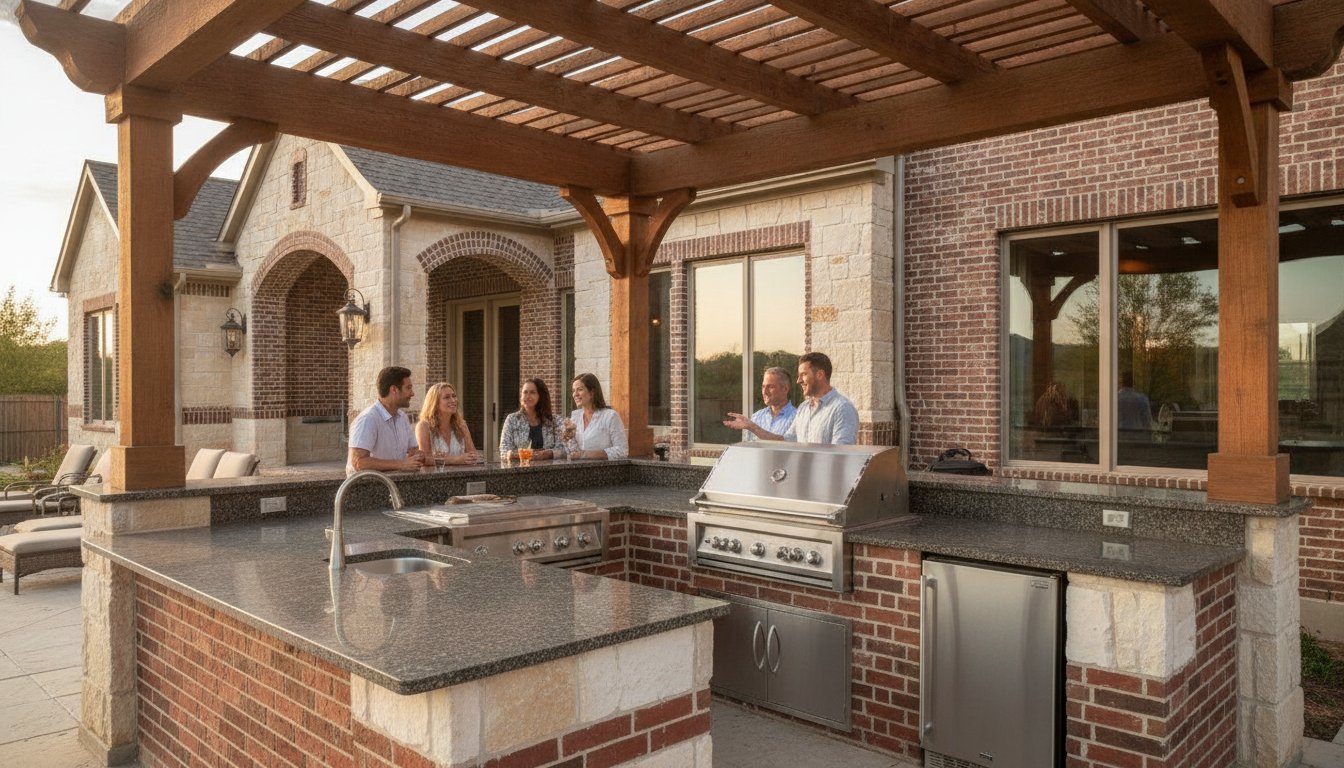
A Pergola traditionally offers an open-air experience that focuses on architectural beauty. While it doesn’t provide a solid barrier against rain, its slatted design creates a beautiful dappled shade effect. This is perfect for poolside lounging where you want to feel the breeze. Modern versions have evolved beyond simple cedar beams. You’ll find sleek options in steel and aluminum that offer incredible aesthetic versatility. These structures define your outdoor space without the heavy footprint of a full roof. When evaluating a covered patio vs pergola for Texas weather, consider how much maintenance you want to perform every spring. While pergolas are often the preferred choice for garden-centric designs, they require a specific commitment to upkeep to stay beautiful in our harsh climate.
The Battle Against Texas Weather: Shade, Storms, and Seasonal Shifts
Living in the DFW area means preparing for four seasons that sometimes arrive in a single week. When you’re weighing the pros and cons of a covered patio vs pergola for Texas weather, you’re really deciding how much of that weather you’re willing to invite to dinner. A pergola is a fantastic architectural statement, but it won’t keep you dry during a sudden Tarrant County downpour. We build our structures to handle the reality of our region, ensuring your investment doesn’t become a kite when those 70mph gusts roll through Keller or Argyle. Our goal is to provide a space where you can relax without constantly checking the radar.
Our approach to building is grounded in reliability and long-term durability. We don’t just look at how a structure looks on day one; we look at how it stands up to five years of Texas sun and spring hail. Whether you choose a solid roof or a slatted design, the structural integrity remains our top priority. You can view our recent patio projects to see how we balance these heavy-duty engineering requirements with high-end custom home aesthetics.
UV Protection and Heat Management
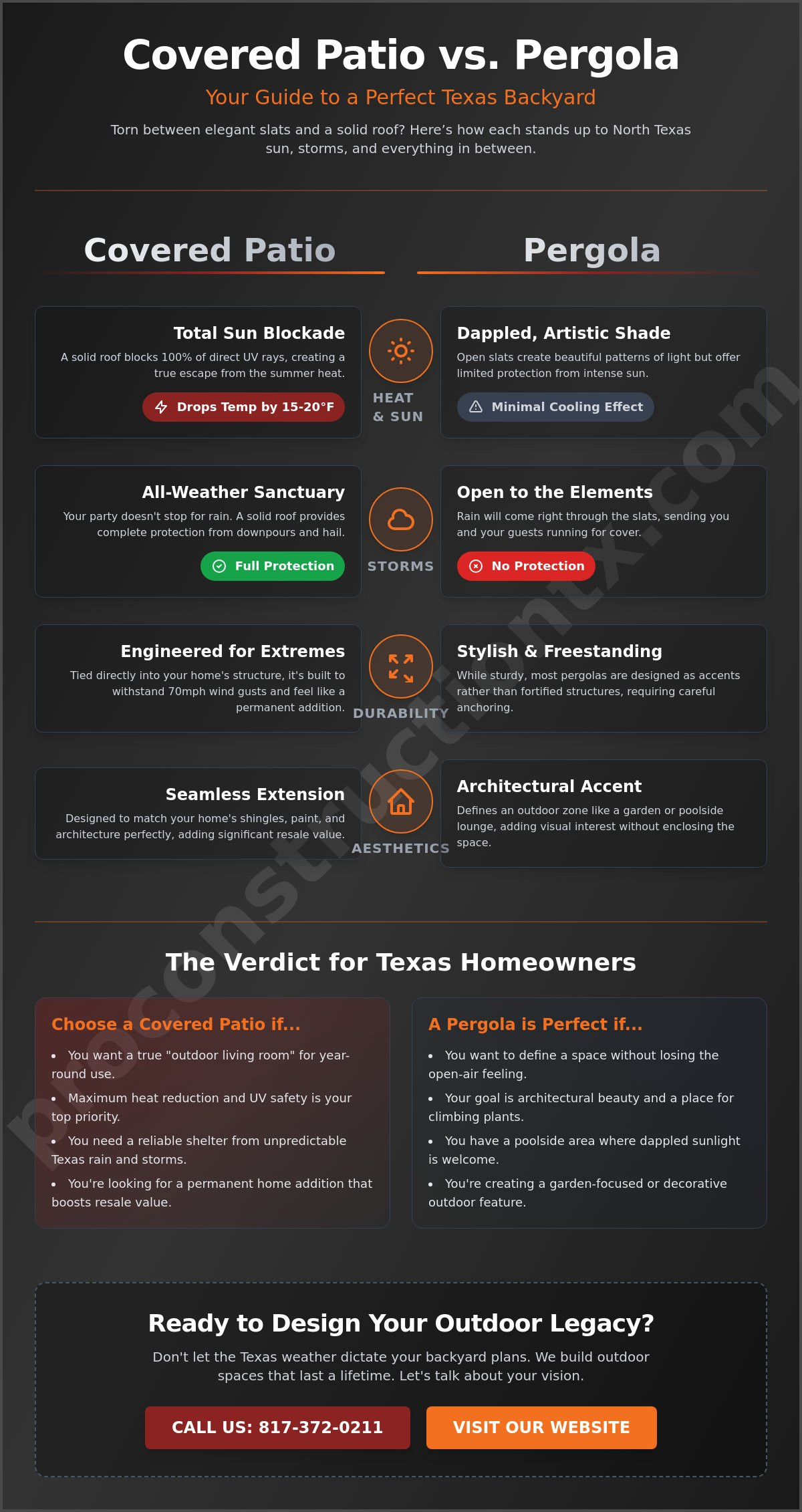
The physics of heat management in North Texas is straightforward. A solid covered patio can reduce the ambient temperature underneath by 15 to 20 degrees because it blocks 100% of direct UV radiation. This creates a true sanctuary during those triple-digit August afternoons. On the other hand, a standard pergola typically blocks only 30% to 60% of the sun, providing what we call “dappled shade.” While pergolas can sometimes feel cooler due to better vertical ventilation and natural airflow, they can’t compete with the total thermal barrier of a roof. To maximize comfort, we always recommend integrating high-output ceiling fans into your design to keep the air moving on stagnant summer days.
Durability During Severe Weather Events
Hail is a fact of life here, and your choice of materials matters. Shingle-matched patio covers survive hail much better than the polycarbonate panels often used on pergolas. We follow strict International Building Code patio cover standards to ensure every project is built to last. Our team utilizes deep-footing anchors in the North Texas soil to prevent uplift during high-wind events. In the heart of Tornado Alley, professional engineering isn’t a luxury; it’s the only way to ensure your outdoor addition remains a safe haven rather than a structural liability. We also design these spaces with the “Blue Norther” in mind, allowing for the easy addition of infrared heaters and motorized screens that keep the space usable even in the depths of January.
Structural Integrity & Design: Integrating with Your Home’s Architecture
Protect your home’s curb value by avoiding the “tacked-on” look that plagues many DIY outdoor projects. When you’re choosing a covered patio vs pergola for Texas weather, the most critical factor is how the structure ties into your existing home. A poorly integrated roofline doesn’t just look bad; it can lead to leaks and foundation stress. We specialize in structural renovation services Tarrant County homeowners trust to ensure that every major backyard expansion feels like a natural part of the original house. This involves meticulous planning to match roof pitches and load-bearing requirements, ensuring the new addition is as stable as the main structure.
Material selection plays a massive role in longevity. Cedar is a local favorite for its natural resistance to rot and insects, but it requires regular staining to maintain its beauty. Treated pine offers a budget-friendly alternative, while engineered steel provides a modern, low-maintenance solution that stands up to anything the DFW climate throws at it. We help you navigate these choices while ensuring your project meets the strict permitting and HOA requirements of Keller, Southlake, and Grapevine. This ensures your covered patio vs pergola for Texas weather decision is backed by local compliance and structural stability.
The Design-Build Advantage for Patio Covers
Manage your project’s lifecycle from the first permit application to the final nail with our design-build approach. We prioritize your home’s existing drainage and foundation, ensuring that a new roof doesn’t cause water to pool against the slab. This collaborative process allows you to choose finishes, like specific shingle colors or tongue-and-groove ceilings, that mirror your main home’s interior and exterior. We take pride in handling the administrative burden of local regulations so you can focus on the finished result.
Pergola Customization: Arbors and Screened Options
Consider adding retractable canopies or motorized louvers to your pergola for a “best of both worlds” solution. These features allow you to enjoy the sun when it’s mild and find shelter when the heat intensifies. Many families are also discovering the benefits of screened porches as a middle ground. These structures provide excellent pest control while maintaining an airy feel. You can even use vertical arbors to create a natural privacy screen from neighboring two-story homes, turning your backyard into a secluded retreat.
Calculating Value: ROI, Maintenance, and Lifestyle Factors
Thinking about the financial return on your backyard project is just as important as the design itself. In our local market, the choice between a covered patio vs pergola for Texas weather often dictates the eventual resale price of your home. Tarrant County buyers, particularly in high-end areas like Southlake and Colleyville, view outdoor living spaces as a standard luxury requirement rather than an optional upgrade. While both structures add beauty, a roofed addition provides a much higher “price per usable day” because it remains functional regardless of the forecast. If you want a space that serves as a true extension of your home, you have to look at the long-term utility alongside the initial build cost.
Return on Investment (ROI) in the North Texas Market
A well-constructed outdoor living space adds significantly to the appraisable square footage feel of a home by seamlessly blending the interior with the exterior. According to current regional data, a solid patio cover typically returns between 50% and 70% of its cost in added property value. This is why many homeowners prioritize custom patio covers Keller TX over more decorative features. If you are planning a high-end outdoor kitchen with premium stainless steel grills and refrigerators, a solid cover is essential to provide the necessary appliance protection from our intense sun and rain. In contrast, pergolas are often classified by appraisers as landscaping features, usually yielding a lower ROI of 30% to 50%.
Long-Term Maintenance Requirements
The reality of the Texas sun is unforgiving on natural materials. If you choose a cedar pergola, you should plan to restain and seal the wood every two to three years to prevent graying and rot. This maintenance cycle is a significant commitment for many families. On the other hand, a roofed patio cover follows the same maintenance schedule as your primary house, offering a “set it and forget it” experience. To keep your space looking new in 2026, we recommend a simple annual cleaning of the ceiling and structural beams to remove dust and cobwebs. Because these structures use standard roofing materials, they are built to last decades with minimal intervention. If you’re ready to start planning your build, you can contact our team for a professional consultation to discuss which material fits your family’s schedule.
Ultimately, your lifestyle goals should drive the decision. A pergola is a perfect, quiet garden retreat for those who enjoy gardening and open-air lounging. However, if your goal is to host large family gatherings or cook full meals outdoors during a July heatwave, the covered patio vs pergola for Texas weather debate usually ends with a solid roof. We take pride in helping our neighbors find that perfect balance between aesthetic appeal and practical, everyday value.
Designing Your Legacy: The PRO Construction Approach to Outdoor Living
Building a backyard retreat is about more than just construction; it’s about creating a space where your family’s best memories will happen. For over 25 years, we’ve built a reputation in the Keller community based on trust, discipline, and consistent labor. We don’t view your project as a simple transaction. Instead, we treat every home addition with the same meticulous planning and care as a full custom build. Deciding between a covered patio vs pergola for Texas weather is a significant choice for your property’s future, and we’re here to act as your dependable partner throughout the entire lifecycle of the project.
Our team takes pride in managing the complex administrative and regulatory tasks that often overwhelm homeowners. If you’re curious about specific permitting requirements in your city or how we manage project timelines, we encourage you to visit our FAQ page for detailed answers. We believe in transparency and want you to feel confident in every beam we place. When you’re ready to start your backyard transformation, you can reach us directly at 817-372-0211 to schedule a conversation with one of our local experts.
From Concept to Completion
We’ve refined a design-build process that anticipates your needs from the very first consultation. This collaborative approach ensures that the technical side of the build never overshadows your vision for the space. As a business deeply invested in our regional landscape, we also offer specialized incentives for the community pillars who serve us every day, including teachers and first responders. By utilizing our expertise as home addition contractors Fort Worth families trust, we ensure that your outdoor structure is engineered with the same structural integrity as a primary residence. This high level of craftsmanship is what allows our projects to stand firm against the volatile North Texas climate.
Your Next Steps for a Better Backyard
Preparing for your initial consultation helps us hit the ground running. We recommend gathering a few items to share with our project managers during your first meeting. Bringing photos of your current space, a copy of your HOA bylaws, and a “must-have” list of features will help us tailor the design to your specific lifestyle. Whether you’ve settled on the covered patio vs pergola for Texas weather debate or still need a bit of guidance, we’ll work together to find the right fit. Always remember that the PRO logo on your project design is our personal signature of quality and local craftsmanship. It represents our commitment to your family’s peace of mind and the long-term value of your home.
Build Your Backyard Sanctuary for the Long Haul
Choosing between a covered patio vs pergola for Texas weather ultimately comes down to how you plan to live your life outdoors. While pergolas offer undeniable architectural beauty and filtered shade, a custom patio cover provides the structural defense needed to withstand our region’s triple-digit heat and volatile storm seasons. We’ve seen how a well-integrated roofline doesn’t just improve your daily comfort; it secures your home’s resale value and protects your high-end outdoor appliances for decades to come.
With over 25 years of North Texas building experience, we specialize in navigating complex structural renovations and strict HOA compliance so you don’t have to. We are proud to offer specialized community incentives for our local teachers, first responders, and public service professionals as a thank you for your dedication. Your legacy deserves a structure built with integrity and local craftsmanship. Start your outdoor living project today with a professional consultation from PRO Construction by visiting our website or calling us at 817-372-0211. We look forward to helping you create the perfect space for your family to gather and grow.
Frequently Asked Questions
Does a pergola or a covered patio provide better shade in Texas?
A solid covered patio provides significantly better shade by blocking 100% of direct UV radiation. This creates a true thermal barrier that can drop the ambient temperature by 15 to 20 degrees. In contrast, a standard pergola offers dappled shade, blocking only 30% to 60% of the sun. For the intense North Texas heat, a roofed structure is the most effective way to keep your outdoor living space usable all summer long.
Do I need a building permit for a pergola in Keller or Fort Worth?
You generally need a building permit for any structural addition in Keller or Fort Worth. While simple ground-level slabs might be exempt, adding a vertical structure like a pergola typically requires city approval to ensure it meets local wind and safety codes. We handle the entire administrative process for our clients, including permit applications and HOA compliance, so you don’t have to worry about the complex regulatory details.
Which structure adds more value to my North Texas home?
A covered patio typically adds more value to your home because it’s viewed as a structural home addition rather than a landscaping feature. In the Tarrant County market, roofed structures often return 50% to 70% of their cost. Buyers in Southlake and Keller prioritize these spaces because they offer year-round utility. When comparing a covered patio vs pergola for Texas weather, the solid roof is the superior investment for long-term property value.
Can a pergola be attached to my house, or should it be freestanding?
A pergola can be either attached or freestanding depending on your backyard layout and architectural goals. Attaching it to your house creates a seamless transition from your indoor living area, but it requires careful structural tying into your home’s frame. Freestanding structures are excellent for creating a distinct destination in your garden or near a pool. Our team evaluates your home’s existing roofline to recommend the most stable and aesthetically pleasing mounting method.
How much wind can a standard patio cover withstand during a storm?
We engineer our custom patio covers to withstand 70mph wind gusts, which is the standard for inland North Texas jurisdictions. Our builders use deep-footing anchors and heavy-duty structural beams to ensure the structure remains stable during severe thunderstorms. In coastal areas, certifications like WPI-8 are required for higher winds; however, for the DFW area, our meticulous planning ensures your investment stays firmly grounded during our local spring storm season.
Can I convert my existing pergola into a covered patio later?
Converting a pergola into a covered patio is often difficult because the original footings and posts may not be rated for the weight of a solid roof. A roofed structure requires specific engineering to handle dead loads and wind loads that a slatted pergola does not. It’s usually more cost-effective to design the space as a covered patio from the start to ensure the foundation and framing are built for long-term structural integrity.
What are the best materials for a low-maintenance outdoor structure in Texas?
For a low-maintenance experience, engineered steel or aluminum are the best choices for the DFW climate. These materials don’t rot, warp, or require the frequent staining that natural wood demands. If you prefer the look of wood, Western Red Cedar is a durable local favorite, though it still requires a sealant every two to three years. Many homeowners in 2026 are choosing hybrid designs that use steel frames with wood accents for both beauty and longevity.
How long does the typical installation take for a custom patio cover?
The construction phase for a custom patio cover typically takes two to four weeks once the materials arrive on-site. However, the total project timeline includes several weeks for design, HOA approval, and city permitting. We manage this comprehensive lifecycle to keep the process moving efficiently. Our project managers provide regular updates so you always know exactly when your new outdoor living space will be ready for its first family gathering.
Disclaimer
Disclaimer: This material is for informational purposes only. While our automotive search engine optimization (SEO) strategies are designed to improve online visibility and foot traffic, we do not guarantee specific search engine rankings, website traffic volume, or vehicle sales. Search engine algorithms change frequently, and results will vary based on market competition, dealership location, website history, and other factors outside of our control. Case studies or past performance metrics shared in this material are examples of prior success and do not guarantee future results.